Sentinel
Multilingual event extraction for submarine cable failures.
Project Overview
Submarine cable failures — from anchor drags off Mombasa to ship strikes in the Red Sea — affect connectivity for entire countries and regions. Yet learning about these events still depends on ad-hoc monitoring: scanning SubTelForum posts, regional press in local languages, and operator mailing lists. By the time a researcher notices an event, the window for active measurement may have closed.
Sentinel is a domain-specific event extraction system that automates this process. It watches a tiered set of sources — operator and industry feeds (SubTelForum, TeleGeography), regional press in French, Portuguese, Spanish, and English, and general news — and uses LLM-based extraction to identify cable failure events. A corroboration engine scores confidence by cross-referencing independent reports, distinguishing new incidents from ongoing ones through two-layer deduplication (document-level and event-level).
The extracted events feed a persistent SQLite database recording the full lifecycle of each incident: which cable, where, when, who is affected, what operators, repair status, and linked source URLs for provenance. This database is designed for two downstream uses:
- Active measurement integration — Sentinel triggers traceroute-based path-discovery campaigns through a bridge wrapper, targeting countries served by the affected cable. Measurement feedback flows back to confirm or refute the reported failure.
- Calypso analysis — The structured event database enables longitudinal study of SCN failures: frequency by cable, region, and cause; repair timelines; correlation with routing changes observed in traceroute data.
Architecture
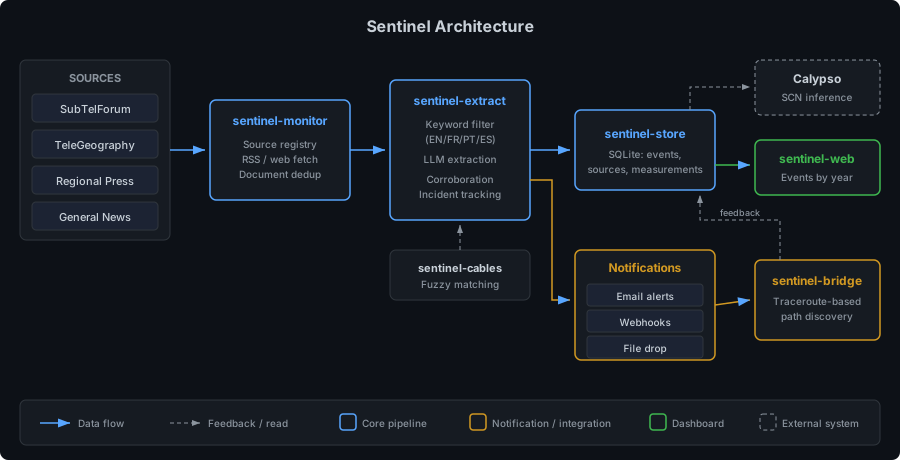
Sentinel’s pipeline flows left to right: a monitor fetches from tiered sources (operator feeds, regional press, general news) and deduplicates at the document level. An extraction stage applies multilingual keyword filtering and LLM-based event extraction, then scores confidence through cross-source corroboration. Confirmed events are persisted in a SQLite store that records the full incident lifecycle — timing, geography, operators, severity, and linked source URLs.
From there, the pipeline branches. A notification fan-out dispatches alerts (email, webhooks, file drops) and can trigger a measurement bridge that launches traceroute-based path-discovery campaigns targeting affected regions. Measurement feedback flows back to the store, confirming or refuting the reported failure. A web dashboard provides a read-only view of all events grouped by year. Downstream, Calypso reads from the store for longitudinal SCN failure analysis.
The system runs as a cron job (sentinel check) given the relatively low rate of cable failures (~100-200/year globally), with a daemon mode available for continuous monitoring.
Notification and Integration
When Sentinel detects a new cable failure event meeting a configurable confidence threshold, it dispatches notifications through a fan-out emitter:
- Email alerts — configurable recipient list, piped through sendmail
- Webhooks — HTTP POST with optional bearer auth for Slack, PagerDuty, or custom endpoints
- File drop — JSON event files for pipeline integration
- Measurement bridge — triggers traceroute-based path-discovery campaigns targeting affected regions
Open Problems
- Extraction accuracy — LLM-based extraction from noisy, multilingual news sources requires careful prompt engineering and ground-truth validation against validated historical databases (e.g., from TeleGeography)
- Source coverage — Expanding beyond English, French, Portuguese, and Spanish to cover Vietnamese, Arabic, and other languages relevant to cable-connected regions
- Timeliness — Reducing the gap between a failure occurring and Sentinel detecting it, particularly for regions with sparse press coverage
- False positive suppression — Distinguishing actual cable faults from planned maintenance, political commentary about cables, and speculation
Related Projects
- Criticality of the Submarine Cable Network — the broader research agenda that motivates Sentinel
- Calypso — submarine cable inference system that uses Sentinel’s event database
People
PIs
- Fabián E. Bustamante (Northwestern University)